

Data Center in Kouvola, Finland
Homes
Business premises
Construction services
YIT Finland
Data centers are being built in Finland at a record pace, and the value of these investments is already reaching billions of euros. The projects will also create a significant number of new jobs. In data center projects, YIT acts as a partner from project development to implementation.
The data center industry is growing at an exceptionally fast pace in Finland. More than forty data centers are currently operating in the country, and new projects are being planned and built in several locations.
The value of the investments is close to the billion-euro mark per project, and the market's turnover is forecast to reach tens of billions of euros in the future.
"Finland is currently one of the fastest growing data center markets in the Nordic countries and Europe as a whole," says Juho Siitonen, the director responsible for building technology and data centers at YIT.
YIT has been involved in the projects for more than a decade and is the leading contractor in the field in Finland. Currently, the company is implementing a data center project for XTX Markets in Kajaani and a data center for Hyperco in Koria, Kouvola.
In public debate, it has been said that the workforce and equipment for the data centers would come from abroad, and other countries would also reap the economic benefits. Juho Siitonen sees it differently. In YIT's projects, the degree of Finnish workforce is kept as high as possible.
“In addition to our own staff, we utilize local companies and professionals. The goal is to create the best possible Finnish team for each project.”
In practice, construction, installation, project management, and most of the implementation are carried out by Finnish workforce. Veijo Terho, Chair of the Finnish Data Center Association FDCA, estimates that a data center project could bring 300–500 additional jobs to a small town during construction.
“After commissioning, the plants will employ an average of 100 people. Local experts are needed to maintain, monitor and service the systems,” he adds.
On the other hand, servers - devices used for processing and storing data - come from abroad, mainly from the United States and Asia, at least for the time being.
“There's nothing we can do about it. There are currently no companies in Finland that manufacture servers,” Terho says.
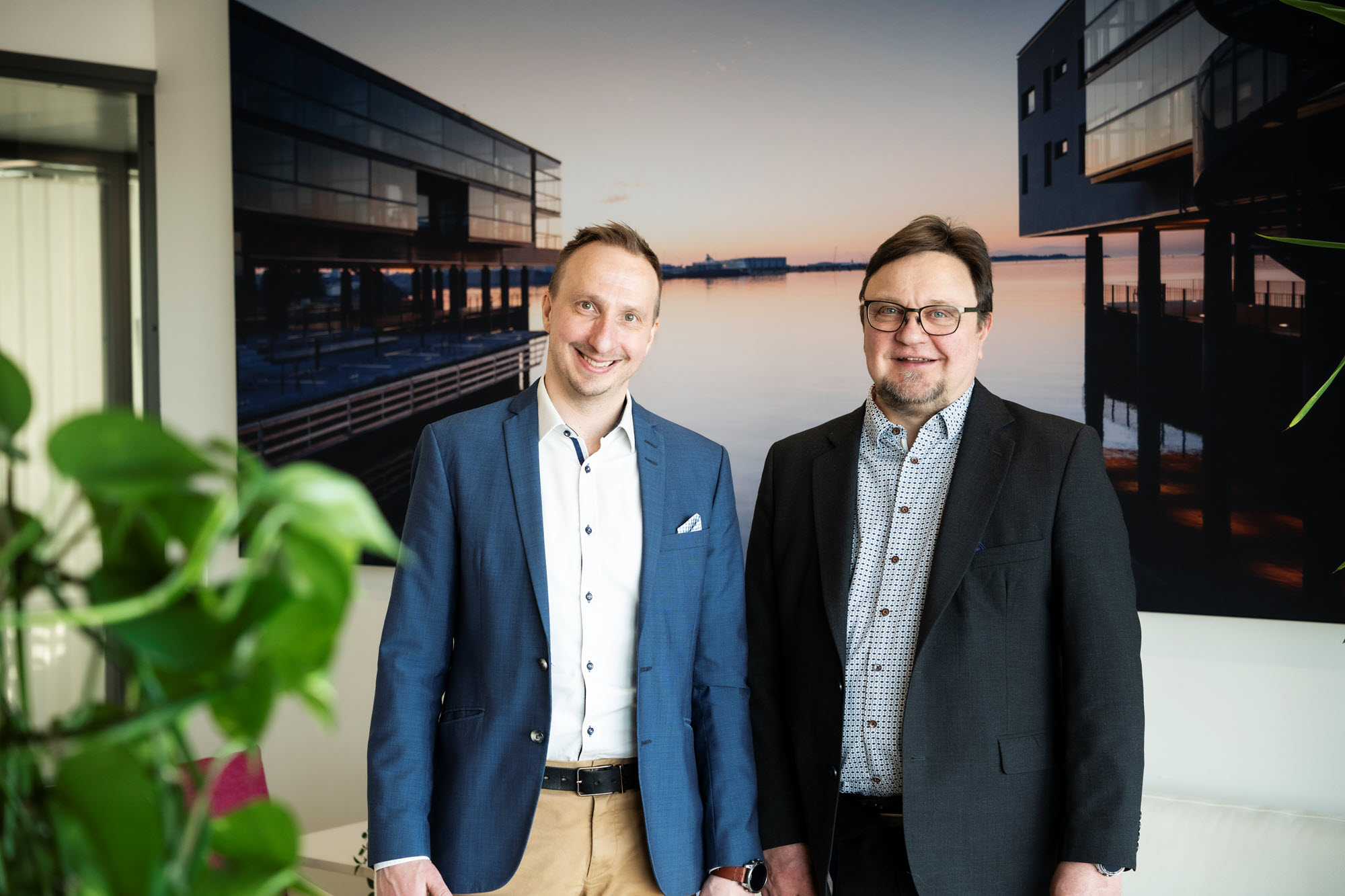
Juho Siitonen and Veijo Terho
According to Siitonen, YIT is a large and reliable partner, whose strength is its ability to bear responsibility for projects from start to finish.
"We can get involved at the beginning of the development phase. We support project development, guide design, take care of procurements and production, and steer the project all the way to commissioning. We also offer property management for data centers,” Siitonen describes.
Data centers are technically demanding entities that combine construction work, electrical and cooling systems, and telecommunications infrastructure. When the responsibility lies with one operator, the customer does not have to worry about putting together a jigsaw puzzle of numerous different contractors. This will streamline and speed up the implementation significantly.
“Speed is one of the key competitive factors in the industry. We have the resources and know-how to carry out even large projects on a tight schedule.”
International operators also value local knowledge, as Finnish legislation, construction requirements, and conditions are often foreign to them.
"We will ensure that the foreign operator's plans are adapted to Finnish standards and regulatory requirements. We also have the know-how to implement projects using international contract models, such as FIDIC terms, which facilitates cooperation.”
There is now plenty of interest in Finland for several reasons. One of the most important is the good availability of electricity, as well as a stable and reliable electricity network. Data centers need electricity around the clock.
Current data centers account for about 2% of Finland's total energy consumption, and the share is estimated to increase to 4% by 2030 as a result of the new investments.
"In Finland, you can get large electricity connections relatively quickly, within 2–3 years, while in the Netherlands, for example, it can take up to seven years," Terho explains.
Siitonen adds that for many foreign operators, renewable energy is an important criterion. It is often what is asked about first. Finland can offer wind power and other renewable energy sources competitively.
In addition, our cool climate allows for free cooling, which means that outdoor air can be used to cool equipment for a large part of the year. This improves energy efficiency.
Waste heat from data centers can be recovered and utilized, for example, in urban district heating networks.
"Utilizing waste heat is a concrete example of how a data center can support the local energy economy and the green transition," says Siitonen.
Terho points out that Finnish technical expertise in design, construction, and plant operation is valued internationally. Finland is also known for its political stability and predictability.
"Long-term investments can be made without fear of unexpected changes to the rules or permit processes. This highlights the importance of the local partner.”
Siitonen emphasizes that Finland is a domestic market for YIT. When the project is implemented here, it is carried out in an environment where the company will continue to operate.
"Therefore, we have a strong interest in ensuring that the solutions are technically sustainable, energy efficient, and function in a responsible manner for a long time," says Siitonen.
Smart solutions improve production performance and create energy savings in industrial applications


