


Data Center in Kouvola, Finland
Homes
Business premises
Construction services
YIT Finland
The construction of data centers is increasing in Finland due to the growth of digitalization, artificial intelligence, and cloud services. Data centers are technically demanding construction projects that require specialized expertise, precise scheduling, and the seamless integration of technical systems to be successful. These 10 questions highlight the key considerations when building a data center.

A data center is a facility where servers process, store, and transmit the data required by digital services around the clock. An increasing portion of our daily lives, work, and leisure takes place in digital environments. Data centers keep our everyday lives running, powering everything from online banking and tax services to electronic prescriptions, healthcare records, education, and countless other essential services. The growth of artificial intelligence, cloud services, streaming, e-commerce, social media, as well as industrial digitalization and IoT, continuously increases the need for data processing and computing power, thereby also growing the need for data centers.
Finland is one of Europe’s most attractive destinations for data center investments. The construction of data centers is supported by a reliable power grid, high-speed data connections, the availability of fossil-free energy, competitive electricity prices, and a cool climate. Furthermore, Finland's comprehensive district heating infrastructure offers opportunities to utilize waste heat from data centers. A stable society and investment environment, combined with good land availability compared to Central Europe, create the right conditions for large-scale data center investments.
Data centers are demanding construction projects that combine structural engineering with sophisticated electrical, HVAC, automation, cooling, and energy systems, as well as telecommunications connectivity.
A successful data center project requires experience with technically demanding projects, the integration of various engineering disciplines—such as structural and building services engineering—and strong project management expertise. The builder must be able to manage the entire scope, from design and construction through to testing and commissioning, adhere to strict schedules, and respond flexibly to changes.
We have been building data centers in Finland for over ten years. We are currently working on several data center projects: a data center campus for XTX Markets in Kajaani, as well as the Hyperco data center and atNorth’s FIN04 campus projects in Kouvola.
It is advisable to bring the builder in as early as the project development phase, while the project's scope, phasing, and schedule can still be influenced. Together with the client and designers, the builder can evaluate how design solutions will impact construction costs and the timeline. It is important to identify certain details early on—such as equipment with long lead times—and to plan how the facilities can be commissioned in phases.
YIT can support the client in project development, design, and the permitting process, as well as take responsibility for construction, commissioning, and property maintenance according to the agreed scope.
YIT can deliver a data center as a turnkey project, providing the client with a single partner for everything from construction to building systems and commissioning.
A turnkey project can be executed, for example, as a general contract where YIT manages construction based on the client’s plans. If the client also wants to consolidate design under the same partner, a design-build contract is suitable, in which YIT is responsible for both design and construction.
Contract terms are agreed upon with the client on a project-specific basis. YIT can execute projects using international FIDIC contract conditions as well as other terms suitable for the project. Download the project model guide.
Construction duration depends on what is being built and when the facilities need to be ready for operation. A data center can be built and commissioned in phases. This means the first server hall can already be in use while other parts of the same site are still under construction.
The schedule is primarily affected by the maturity of the plans, the availability of power supply, and the lead times for key equipment such as transformers and cooling units. Time must also be allocated for testing.
YIT plans the implementation together with the client by working backward from the commissioning targets for each phase. This ensures that from the very beginning of the project, everyone knows when plans must be finalized, equipment must be ordered, and spaces must be ready for installations and testing.
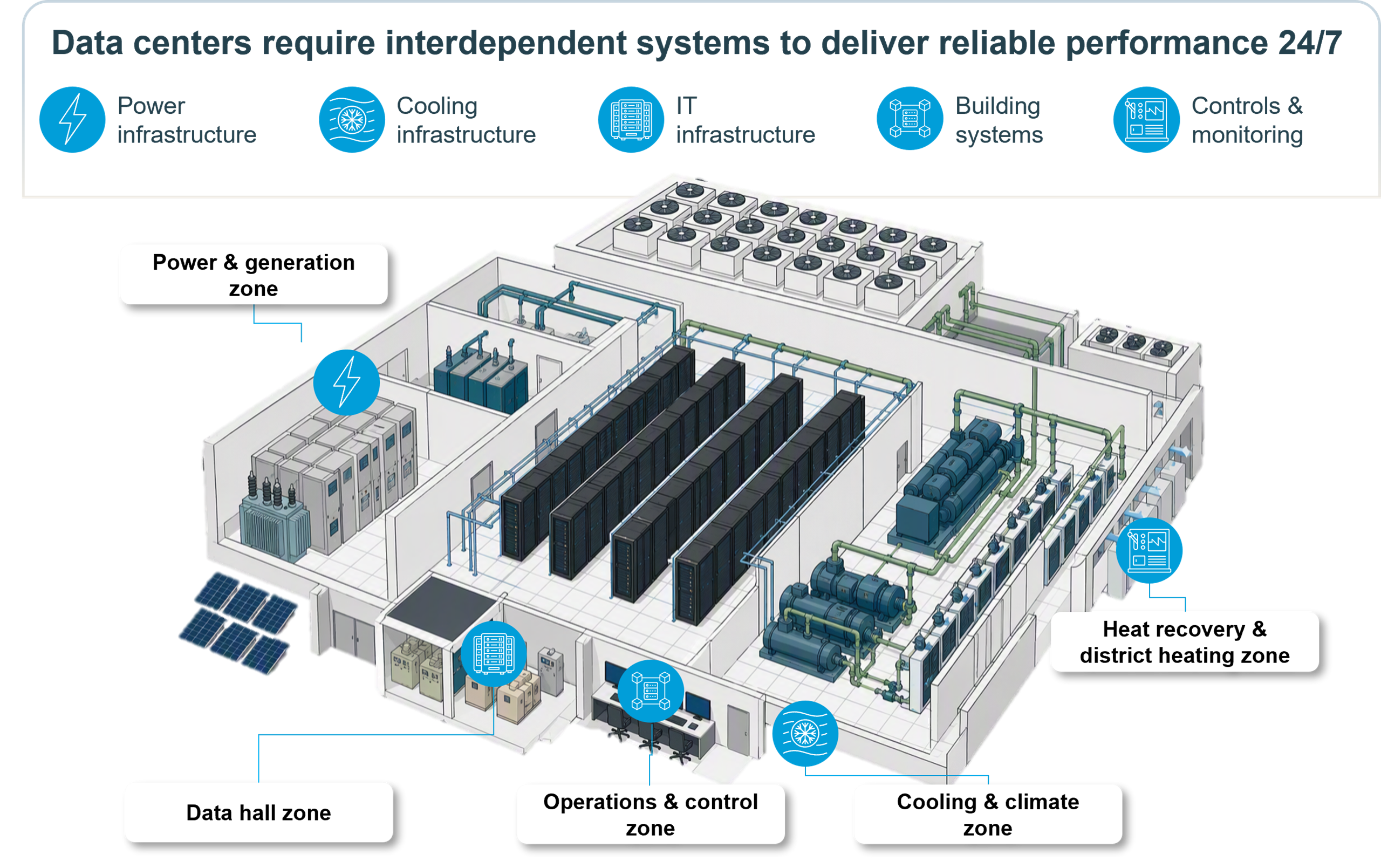
The technical complexity of a data center stems largely from its systems. Construction integrates electrical, HVAC, water, ventilation, automation, security, cooling, and energy systems, all of which must function as designed and with high reliability. Building systems are therefore an essential part of YIT’s data center construction. For example, the data center projects YIT has implemented for XTX Markets in Kajaani also include the building system contracts.
The purpose of data center testing and commissioning is to ensure that all technical systems operate as designed, safely and reliably, as one integrated whole. Successful commissioning requires close collaboration between construction teams, building services contractors, and equipment suppliers from the early stages of a data center project.
In YIT’s data center projects, testing and commissioning proceed in stages, starting with installation inspections and equipment supplier tests, followed by system-specific functional testing, and finally Integrated Systems Testing (IST).
Before the data center becomes operational, critical systems such as power supply, backup power, cooling, and building automation are tested using simulated loads, including under simulated fault conditions and outages. Thorough quality assurance and comprehensive documentation ensure a smooth transition to live operations.
A data center’s electrical systems are essential for ensuring operational reliability and round-the-clock availability. Since data centers operate continuously, 24/7, reliable power supply and cooling are critical. Even a brief disruption can result in significant financial losses and compromise the operation of IT systems.
Data center power supply reliability is ensured through redundancy, including duplicated power supply paths and equipment, as well as backup power systems (uninterruptible power supplies (UPS) and backup generators). These systems ensure that a single equipment failure or scheduled maintenance does not interrupt data center operations.
In data center construction, electrical, backup power, automation, cooling, and energy systems must be seamlessly integrated with the building infrastructure. In YIT’s data center projects, the implementation and coordination of these critical systems are also an integral part of the overall construction process.
Key factors in selecting a plot suitable for a data center include sufficient power availability and grid capacity, the buildability of the site, adequate developable land area, and good transport and telecommunications connections. Completed zoning and necessary surveys can expedite the implementation of a data center project. Furthermore, a location near a district heating network and a commuting area supports the utilization of waste heat and the availability of labor.
YIT helps in identifying and developing data center plots.


